
Showing posts with label Architecture. Show all posts
Showing posts with label Architecture. Show all posts
26.8.13
No cue for cats
The only difference between the two pictures is that there are no people cueing to see Mouser on top of the Waterloo Lion's Mound.


1.12.12
Visit to the Royal Palace Het Loo
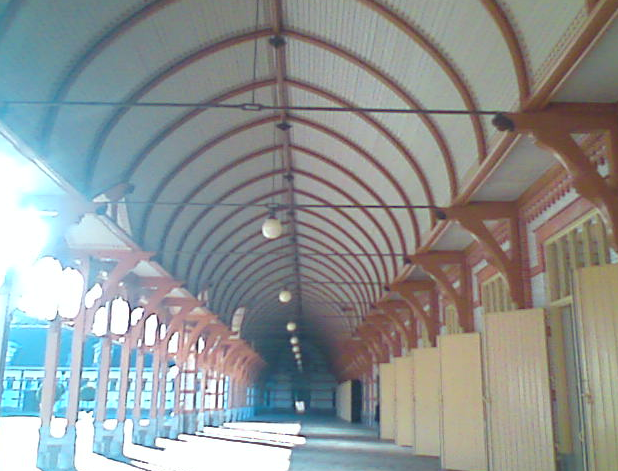
One of the chief stable managers showed us around, locking and unlocking doors to rooms where the public is not allowed to come.
 After the stable tour we visited the palace itself. It was the object of much discussion and controverse in the eighties when restaured. The romantic garden was demolished and a 17th century garden planted instead. A lot of the rooms that had been changed were remodelled according to the original Daniel Marot designs and contemporary accounts of visitors to the William & Mary hunting pied-a-terre.
The arrangement and furnishings of the room do give an excellent idea of the shift in styles in furniture and interiour design from the late 17th century up till the 20th.
If you're not really very versed in furniture periods etc. I recommend the audio guide, which does give a lot of context about the kings and queens who resided there too.
 On the whole, we as art students enjoyed discussing the furnishings. It was an agreeable visit. Alas we didn't have time to stroll around in the forest next to the castle. I think a visit is worthwhile, but if I were to return, I'd come back in spring or summer to explore the grounds too.
23.7.12
Dig it!
 From tomorrow 'till 29th of July there is Dig the City @ Manchester. This is a picture from one of the roofs of Manchester Cathedral taken by someone setting up some lighting stuff for the festivities.
 Looks like the drains are blocked. Probably the empty gin bottles and other rubbish found there are covering every possible water evacuation hole. I probably do not need to point out that this is detrimental to the building. And health in general.
Headless birds floating in the water.
I spy botulism....
19.5.12
Remodeled church excursion in Maastricht (4)
 Before reaching the next remodelled church, we strolled around the narrow streets. I was straggling because of my poor back condition and paused to stop and enter buildings that looked inviting from outside. I must say, these University buildings, they're very big on covering courtyards with glass.
  I stumbled into the ICIS building (International Centre for Integrated assessment and sustainable development). What an agreeable space the court yard is. Even in the Nieuwenhof building the common room had a glazed roof.
  Last on the list was the Dominican church, now a bookstore. It is the text book remodeling project that always shows up in glossy magazines, along with the Kruisheren hotel.
We were not disappointed.
Again, a very different atmosphere going from blazing sunlight to the slightly muted atmosphere that still clings to church buildings, even though it is a shop with people bustling in and out and a cafeteria located in the choir.
 I've noticed how everyone in the group tended to sink their voices to the level of a murmur. Very strange that a building can have that sort of an impact on behaviour.
I'm sure we're all very good mannered, I know a lot of people can't even be quiet even in a church that is still consecrated.
Again here was opted for the placing of a big boxy thing in the length of the nave.
 It's a steel construction holding books, staircases and some little information desks. Again, this construction can be removed if the whole space of the church is needed in future.
 From the platforms one can overlook the rest of the church and the murals on the ceiling. It is actually pretty busy, people going in and out all the time. Notice how some grave stones were still in place and the polished concrete floor was placed around it.
 In a side chapel, where a cosy corner has been made, the rabbit Nijntje got the place of honour among the children's books.
In the place where the main altar used to be a cross shaped table has been placed. Alas, we didn't have time to get some coffee and cake (oh my how those cheese-cakes looked absolutely delicious!).
 Again, some lights in the chandelier didn't work and I got all upset again.
 Oh, and books on architecture are to be found on the first floor.
Anyway, after this very brief trip to Maastricht, we were all very happy to have seen some examples of remodeling.
I would love to see more of these projects in Belgium, but as things stand, we're lagging behind a good 20 years or so.
There's plenty of stuff to be done here, hundreds of parochial churches are empty as we speak and hundreds more are to follow. Strange how remodeled churches are still some kind of taboo over here.
But things are slightly changing. It will take a while, hopefully not too long, or unused churches will begin to fall down of their own accord.
18.5.12
Remodeled church excursion to Maastricht (3)
 Next up on our list was the former Kruisheren church and adjoining monastry. lt was heavily restored around 1912 and had been empty for about 20 years before being turned into a 4 star hotel. The nave and apsis now double as reception, lobby, dining area and wine cellar.
  The kitchen is very clumsily located in one of the cloister wings around the inner court, and service has to make its way up all the tiny, steep, tricky steps to get to the top floor of the big boxlike construction in the middle.
Our professor called it a 'design-hotel', I'd rather call it a 'boudoir-hotel', it had that kind of Malmaison feel to it.
Which incidentally, he didn't know at all. Meh, these academics really don't get about.
Or they get really cheap hotels for digs when lecturing abroad.
 Anyway, we entered through a glitzy copper funnel, which is supposed to be womb, a the side of the nave. The reception desk is to the right with a towering glass lift giving access to the rooms located on the first and second floors and the restaurant on top of the box construction in the nave.
Sunlight filtered in through the west windows and livened up the space.
 We proceded first to take a look at the court yard, which was a huge contrast compared to the dark and serene tone of the interiour of the church. The court yard was (clumsily) paved with white stones and reflected so much sunshine that the eyes had to adapt for quite some time.
 It was not a very welcoming or
 relaxing atmosphere, it could have been a real green garden. Shame. Even the permanent stone furniture lacked something.
 We went back to the nave and strolled around the big boxy thing. Underneath is a dining room for private meetings that can be closed off, one wall is the wine cooling installation. In the apsis there is a bar with boudoir-like seating.
  Some lights worked into the floor around the bar were broken, also a LED strip to mark the step was defective in one area. It's a force of habit, I can't help but notice these things.
 The toilets were also very interesting, with one side of the cubicle in see trough glass. It has a biblical inscription on it to reassure you no one can see you do the business.
 "And the eyes of them were both opened. And they knew that they were naked: and they sewed fig leaves together and made themselves aprons." (Gen 3:7).
To be continued...
17.5.12
Remodeled church excursion to Maastricht (2)
 After we were turned out of the Frior Minors church in Maastricht we proceeded along the remnants of the city wall to our second remodelled
 chapel at the site of the former Nieuwenhof convent. It is now used as an auditorium and part of the University College of Maastricht.
We were spoken to when we were about to enter the building.
Professor: 'There is a woman behind a counter there, she will probably want to see some legitimation.
Act as if you are students who come here every day.
Don't look at her and just keep going. Then turn right once you're inside. And hide your camera's you all look like tourists.'
 We made it to the door of the chapel and then noticed the paper stuck to the door: 'Panel in progress'.
The professor opened the door as silently as possible and gestured we could go in. An inspirational mosaicked doormat said "EERBIED" (deference) as we crossed the threshold.
 We had a little wait in the apsis (completed in the year Columbus discovered America; 1492). It has 5 beautiful stained glass windows. I managed to take a few pictures, the sun outside helped to light them just enough.
 The nave ceiling is from 1665, which is obvious judging from the shape and style compared to the rest.
Then we heard some applause and students filed out of the building.
 We had the room to ourselves and I managed to take some pictures and some of my fellow engineering-architect students commented on the construction materials used.
Then it was time to move on to yet another remodeled church.
To be continued...
16.5.12
Remodeled church excursion to Maastricht (1)
 On Monday we visited a couple of remodelled churches in Maastricht.
Me and my five fellow students got into the professor's car and headed toward Maastricht, just across the border.
He just managed to avoid running over three cyclists before we got to the car park.
The first church, the Church of the Brothers Minor currently the provincial archive of Limburg, was closed (as I had told him before we left), but he didn't seem to believe me.
 The gate was open however and we got as far as the courtyard before we got turned out.
A lady, who was smoking a cigarette, spread her arms shouting: 'No, no, you can't go in. Were closed on Mondays.'
Professor: 'But we've come all the way from Belgium with some students to visit the former church'.
Lady: 'No, sorry.'
Professor: 'Does so-and-so still work here?'
Lady: 'Yes, he does.'
Professor: 'If I would ask you to fetch him, could we then look at the church.'
Lady: 'No.'
 Professor turns his back to her and speaks in loud voice: 'This is so typically Dutch. All these little rules and they sticking by them. If we were in Belgium, they would have let us in just for a quick peak inside.'
Then we proceeded to the front of the building, where they did some post-modern crazy thing. It's to remind us that the old city wall used to be there. If you spun round you could see it. Not sure what the hideous toilet was doing there.
But I suppose if you gotta go, you gotta go.
 It was such a lovely day, the view down the alley with the terrasse reminded me of little pretty Aiges Mortes in the Camargue.
To be continued...
9.5.12
Enchanted with Disenchanted Night
 I found a parcel in the letter box today. It was all in one piece and dry!
I had ordered Disenchanted Night. The Industrialization of Light in the Nineteenth Century by Wolfgang Schivelbush together with Neumann's Architecture of the Night.
It took quite some time to get here, but fortionatly it did not end up in a ditch somewhere as I thought a rancorous parcel delivery person might have chucked it there.
Anyway, the book is an entertaining read, and has its social contexts set down firmly, which I very much appreciate.
I also chuckled at the dedication: "[...] and with special thanks to Capers Rubin who helped so much in the de-Teutonisation of this book.".
27.4.12
Bookbending the rules
 Here's more stupid from one of the other continents in the Western hemisphere!
I ordered a book online. I've had trouble with couriers leaving a parcel at the door without me signing for them. That's not the actual problem, but when I get home it has usually rained half the day and my book is soggy.
Not all shippers wrap the book in some kind of extra plastic for weather proofing.
So: I hung up a sign next to the front door saying 'please leave parcel in car port so contents does not get wet'.
Usually if I'm not home, the courier leaves a note in the letterbox, bla bla, will call again tomorrow...
You know the drill.
Now I had a track & trace number on the parcel and it said 'delivery executed today at 8.17pm'.
But I was home yesterday and I saw no courier and did not have a book, albeit it being pre-paid.
So me, this morning, on the phone to the customer service of the book shop complaining about the missing parcel.
The help desk person sent me the slip of the shipping note, because 'somebody' had signed for it.
I opened up the email attachment and: lo and behold: someone had forged my signature.
Me very angry about this of course. This is not the first time I had trouble with the shipping company before (not FEDEX fyi).
Help desk person said she'd log a complaint with shippers (also not their first complaint either) and refund me for missing book.
Me slightly disappointed at not having book, but relieved at someone sorting problem out.
This afternoon when I got home I decided to ransack the car port in case I missed the parcel before going to the police to file a complaint for identity and property theft.
So after a good 15 second rummage around: Lo and behold: parcel left there by courier. DOH!
Me on the phone again with customer service to plead with them to drop the complaint against shipper.
Book Lady: 'Too late, I've already sent the complaint (where's inefficiency when you need it!). I don't think it is very nice of someone to forge your signature anyway.'
Moral of the story:
1) Me ashamed for tricking a courier into breaking the rules and him/her signing off on a parcel that should have been taken away again.
2) Me worried because said courier will have received a complaint against him/her from the people upstairs and will never ever again leave my parcel in the dry car port of the unthankful people ordering books.
He/she was being altruistic and I jumped to conclusions too easily.
Mea maxima culpa.
But I have my book now, so I'm pleased right now.
If you're wondering which one, it's Architecture of the Night. The illuminated building edited by Dietrich Neumann.
18.4.12
Speakers in al Azhar mosque, Cairo
 I found an image in the 1930's Dutch catholic magazine I'm leafing through, of a completely new Philips-speaker installation in the Al-Azhar Mosque in Cairo, Egypt. You can see a man putting up a sign in the court yard saying 'Philips Radio' and the Philips star logo.
This must have been installed ca. 1936 under the auspices of Mustafa al-Maraghi who was rector at the time.
The author of the little text clarifying the picture applauds the use of modern technology for religious services. He writes: 'In our country people are hesitant toward or reject outright the idea of speakers in a catholic church. The muslims thinks differently about the application of modern technology and have just installed a completely new speaker-system!'
13.4.12
Cemeteries of the Great War by Sir Edwin Luytens
 I just can't help myself. I ordered another book just before the Easter weekend and it was here on Tuesday.
In light of the commemorations of the start of the First World War I'm sure I'm going to be doing some guided tours here and there, so to brush up on post-war building I am going to use Cemeteries of the Great War by Sir Edwin Luytens by architect Jeroen Geurst [OIO Publishers].
The book first of all puts Luytens work in the Interbellum context and then deconstructs every aspect of the cemeteries. From the shapes of the headstones to the trees and landscape layout.
The second part of the book is an alphabetical listing of most cemeteries with their most distinguishing features, 2D layouts (hurrah!) and 3D maps.
It has a very neat lay out, the book is decked out with nice pictures and the author's discourse is very clear and straight to the point.
The format is pretty practical to take with you to look something up if on site, albeit it being a good 470 pages.
12.4.12
Rebel without a Specola Vaticana
 I stumbled upon a review of the inauguration of two new telescopes of the Vatican observatory at Castel Gondolfo in the mid 1930's. The Specola Vaticana at that time had a Zeiss Visual Refractor Telescope (aperture 40mm, focal lenght 600mm, and a Zeiss double astrograph installed in the pope's summer residence 24 km south of Rome. It chose this location and moved out of the Vatican gardens because of light pollution tightening the grip on modern Rome.
  The article contained a picture of Pope Pius XI standing outside the observatory talking to father Johannes Stein, the Dutch director of the Vatican Observatory. It reminded me of another scene in front of an observatory. I was thinking of the famous knife fighting scene in Rebel without a cause at the Griffith Observatory in Los Angeles.
 Sure, James Dean is no pope (and vice versa), but there is an eery similarity between the two settings...
10.4.12
Gothic Revival beer tasting
 I suppose most people spent Easter eating loads of jummy stuff or hunting for eggs. Dr Livingstone, Miller B, his spouse and myself went to a beer festival in a decommissioned neo-gothic chapel. How much more Belgian can you get?
The Lady chapel of the hospital, in the Gothic Revival style, was completely restored in 1998-99. It was built and inaugurated in 1905 and was designed by Peter Langerock. The seven neo-Gothic stained glass windows were designed by Gustave Landon a glazier from Ghent. In 1926 the walls were decorated with neo-Gothic designs. The frescoes of the Cross, along with two other painted scenes of St. Francis of Assisi and St. Elizabeth of Hungary were made by Hungarian painter Gábor Balogh Bëod.
Alas Miller B's wife doesn't like beer and Dr Livingstone volunteered to be Bob (that's the designated driver for you non-Belgians). So it was just down to two of us to order beers and pass them around to taste.
Dr Livingstone did order just one, which none of us liked. It seemed stale, no foam when the beer was poured out. It didn't actually taste of anything special, so it was a bit sad to have to clear away a full glass.

We started out with blond beers Vossen met de Meynen and Excalibur, accompanied by Dr Livingstone's St Bernardus' Wit. It was a pity, he had been looking forward to tasting this, it had been on his to do list for some time.
He did order a dark low alcohol dinner beer by Bavik brewery.
We had some amber beers for our second helping. Miller B moved on to Buffalo Bitter and I decided on a Cuvée des Trolls.
Last order consisted of dark beers Val Dieu and Dikke Mathile.
 I asked Miller B if he had ever dreamed he'd one day be drinking beer in the very same chapel where he had to go to mass on Sunday.
Roman Catholics are not averse to using alcohol during mass, but they're not too big on beer fermented after bottling. Body of Christ-wise.
It was fun, albeit a bit short. We should have had some bread to clean the palate in between because after my first beer I could not really distinguish other tastes clearly.
Anyhow, I did have a slight lingering head ache on Monday...
1.4.12
Dat is architectuur
 I've been ill the last couple of days. Another whopping big attack of sinusitis complete with fever, the works.
Typical, two weeks no classes because of the Easter holidays and I'm struggling with a blocked head.
In the mean time I'm trying to do serious reading work, working on a presentation due in three weeks, working on my paper and preparing for my exams at the end of term.
I finally got hold of the book that is compulsory reading for my Architectural Theory class Dat is Architectuur!
I ordered a second hand version of it last february (it was half the price of a new edition) but the delivery service (TNT) couldn't find my house and subsequently lost the entire shipment.
Luckily I got a refund. I'm not going to order anything anymore through the bookshop's webshop if it can only be delivered through via courier.
So I went to the shop and bought a new book.
26.3.12
Is high-tech modern architecture dangerous?
 An interesting piece in the New York Post on Saturday.
 An octogenarian smashed into an Apple store window.
“Apple wants to be cool and modern and have the type of architecture that would appeal to the tech crowd,” said her attorney, Derek T. Smith. “But on the other hand, they have to appreciate the danger that this high-tech modern architecture poses to some people.”
Several interesting but very different ideas expressed in this little quote.
Let's analyse:
1) There is a type of architecture that appeals to the tech crowd
2) High-tech modern architecture poses a danger to some people
3) There is such a thing as high-tech modern architecture
4) The client has to appreciate his dangerous commisioned architecture
"Evelyn Paswall, a former Manhattan fur-company vice president, claims the tech company’s signature glass architecture is a menace to little old ladies after she failed to see the glass door at a Long Island location and smashed her face."
I'm sure Bruno Taut is turning in his grave.
Glass Architecture a menace to little old ladies. Paswall. Oh, the irony.
©Picture Apple Store Manhasset: Apple.com
20.3.12
Lottery Insulation
 Dr Livingstone and myself have been pretty selfish.
 On Monday we closed the shop early (by half an hour -gosh!-) and went to a building exhibition.
We've been meaning to insulate the house as much as we can to cut back on our heating bills (heating oil is expensive!).
We're nearly at the 1€ mark for one litre!
We've already signed a contract to have the old double glazing replaced by something far more
And we've had some pretty strong ideas on what we would like on top of the roof and the outer walls, but were kind of stuck on what to go for and were not able to pick up the right information without spending loads of time on teh intertubez.
So we used our freebie tickets and made our way from one slimy salesman to another (I spotted at least one with a toupet).
One of them even (not sporting any hair) recognized me from way-back-when he used to run a newspaper store in a small village I used to live once upon a time.
I've been searching my memory and I can't even remember where the shop was.
Anyway, in the end we came away with a pile of information brochures, some telephone numbers and appointments with people coming to look over the house for: signs of water infiltration, combatting damp patches on walls and measuring for new wall insulation.
We were very elated once we got back and hope we will end up with a nice clean salute to the Modernist Movement once all this is over and done with.
First we need to pick the winning lottery numbers and then we'll be fine!
17.3.12
Nun-approved wax
 Way back in the 1930's cooperations were testing the water and seeking out new fishing grounds to flog their products.
Johnson's Wax Company advertised in Roman Catholic Magazines.
A Dutch 1933 ad shows a nun slaving over a wooden floor, scrubbing and polishing away.
On the opposite side we see a nun standing next to a Johnson fluid wax can looking quite pleased.
 'Hundreds of children! and yet.... all floors stay brilliantly clean!'
Looks like Johnson Wax is just in the nick of time to save the dear sister from some nervous break-down or a few kids from some corporal punishment involving a ruler of some kind.
At the time of the ad SC Johnson & Son had 4 factories employing some 50.000 workers. The main Dutch office was located in THe Hague.
16.3.12
40th anniversary of the death of modern architecture
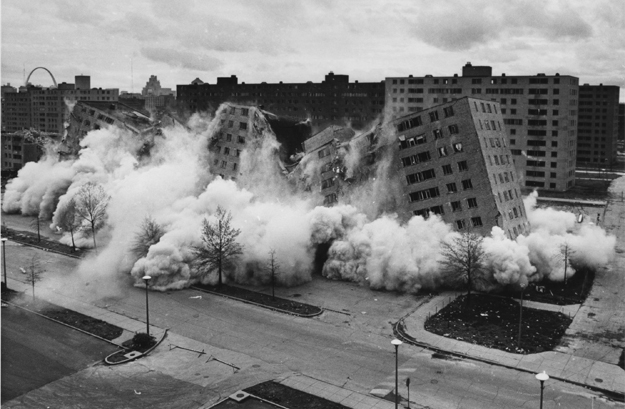 Today, we commemorate the 40th anniversary of the death of modern architecture!
According to Charles Jenks, it died around 3 p.m. on March 16, 1972.
The urban housing of Pruitt Igoe in Saint-Louis an appartmentblock (designed by Minoru Yamasaki & George Hellmuth) was demolished, 16 years after it was built.
Today it is mostly referred to as the icon of failed public housing.
A recent documentary tries to reconstruct the context of the demolition, which is very layered and complicated.
9.3.12
Moving Pulpit
 Modernity really kicked in during the 1930's in churches and hospitals/old folks homes run by brothers and sisters of various religious orders.
In Amsterdam, in the Gesticht van Liefde St Bernardus, a moving pulpit was used and rolled to the middle of the chapel to facilitate the (plentiful) elderly who were hard of hearing.
It was made of wood on a pedestal, placed on two rubber wheels and two supports at the front. At the sides there was an iron rod to prevent the thing from flipping over during the sermon and to easily move it about.
It measured 0,80 x 1,05 meters and was 1,4 meters tall.
A microphone could be secured at the front so speakers could be used in the back of the chapel, or in other parts of the hospital so those who could not get out of bed could hear the service.
Here's another crazy moving pulpit contrapion in Carlisle (UK).
7.3.12
More lives than one
 Today, a new book was delivered by the postman, who, very annoyingly, drove his moped all the way up to our front door!
 It's More Lives Than One(1938) by Claude Bragdon, best known for being the architect who designed the New York Central Station, Rochester, N.Y. (alas, demolished).
I came across Mr Bragdon while doing research for my paper on electrical lighting in churches and he seems to have dabbled in church and lighting design.
Bragdon is a very interesting, but strange character. He was a theosophist, following the writings of Madame Blavatsky.
 On a different note, there is a very interesting book I recommend, alas it has not to my knowledge been translated yet.
It is De geheime wereld van James Ensor [The Secret World of James Ensor] by John Gheeraert.
I think it should be translated because it recounts a very interesting period in Ensor's life while Blavatsky was in Ostend writing her Secret Docrine (published in 1888) and, according to Gheeraert, he was fascinated with her and her ideas.
The author Gheeraart says: 'The key to Ensor's secret lies in his Brussels period. There he got into contact with the famous freethinker Ernest Rousseaux. I further discovered that the co-founder of the Theosophical Society, Helena Blavatsky, between 1886 and 1887 a year in Ostend and lived there her "secret doctrine" wrote the bible of the theosophists. My research showed that Ensor, in his most creative period, much of the esoteric works were derived from Blavatsky. But Ensor was also friends with famous Asia-traveler, Alexandra David-Neel. She also spent some time in Ostend. I discovered such totally unexpected sources that provided insights about a painter whose life is usually seen as 'boring'. "
The book does teeter on the edge of fiction as it is not a full-blown biography, but still some interesting stuff.
Subscribe to:
Posts (Atom)


