Showing posts with label Art. Show all posts
Showing posts with label Art. Show all posts
13.5.13

2.1.13
Menace of the interior

I tried to make it more light to write about interiors in comedy movies, but I got bogged down in philosophy and it turned out to be quite meta and is probably unreadable for lay people.
The professor I'm writing it for did get her post-doctoral degree in philosophy in München, so I hope she'll like it.
Here's the abstract:
"This paper explores the impact furniture and it surroundings have on the protagonist in neo-realist comedy. It is an exercise in combining formalist film theory with design studies, which both analyze forms of visual arts.
In the introduction the outline for a definition of the neo-realist comedy genre is sketched and the delineation of film theory is given and some philosophical underpinnings of design study are touched upon.
Using several examples from 1950’s, 60’s and 70’s movies the argument is made that furniture exerts a power and hold over individuals. The underlying mechanisms are exposed throughout and common denominators analyzed by using theories explored in interior design studies.
Not only do some pieces of furniture pose as a menace to comfort and dignity, but also to reputation and -ultimately- life itself. Each category of menace is elaborated on. Some contemporary examples will be linked to the ideas behind the set design or revealing the unseen and unexplained.
It concludes that furniture serves as a gimmick on several levels to support the alienation of the individual in the society that is shown in cinema."
The title is: 'The menace of the interior. Furniture in neo-realist comedy' and it will probably never get published!
1.12.12
Visit to the Royal Palace Het Loo
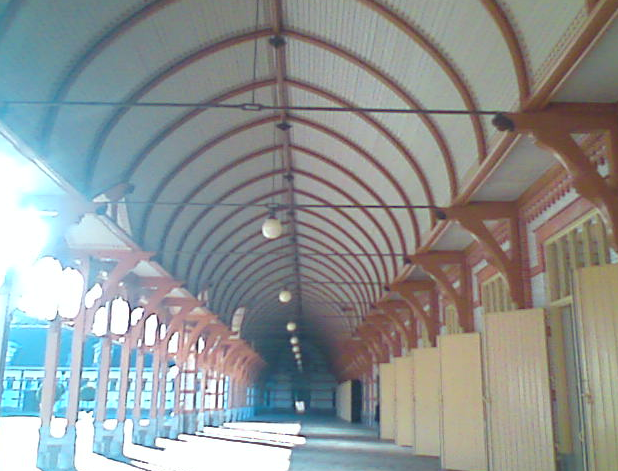
One of the chief stable managers showed us around, locking and unlocking doors to rooms where the public is not allowed to come.
 After the stable tour we visited the palace itself. It was the object of much discussion and controverse in the eighties when restaured. The romantic garden was demolished and a 17th century garden planted instead. A lot of the rooms that had been changed were remodelled according to the original Daniel Marot designs and contemporary accounts of visitors to the William & Mary hunting pied-a-terre.
The arrangement and furnishings of the room do give an excellent idea of the shift in styles in furniture and interiour design from the late 17th century up till the 20th.
If you're not really very versed in furniture periods etc. I recommend the audio guide, which does give a lot of context about the kings and queens who resided there too.
 On the whole, we as art students enjoyed discussing the furnishings. It was an agreeable visit. Alas we didn't have time to stroll around in the forest next to the castle. I think a visit is worthwhile, but if I were to return, I'd come back in spring or summer to explore the grounds too.
19.5.12
Remodeled church excursion in Maastricht (4)
 Before reaching the next remodelled church, we strolled around the narrow streets. I was straggling because of my poor back condition and paused to stop and enter buildings that looked inviting from outside. I must say, these University buildings, they're very big on covering courtyards with glass.
  I stumbled into the ICIS building (International Centre for Integrated assessment and sustainable development). What an agreeable space the court yard is. Even in the Nieuwenhof building the common room had a glazed roof.
  Last on the list was the Dominican church, now a bookstore. It is the text book remodeling project that always shows up in glossy magazines, along with the Kruisheren hotel.
We were not disappointed.
Again, a very different atmosphere going from blazing sunlight to the slightly muted atmosphere that still clings to church buildings, even though it is a shop with people bustling in and out and a cafeteria located in the choir.
 I've noticed how everyone in the group tended to sink their voices to the level of a murmur. Very strange that a building can have that sort of an impact on behaviour.
I'm sure we're all very good mannered, I know a lot of people can't even be quiet even in a church that is still consecrated.
Again here was opted for the placing of a big boxy thing in the length of the nave.
 It's a steel construction holding books, staircases and some little information desks. Again, this construction can be removed if the whole space of the church is needed in future.
 From the platforms one can overlook the rest of the church and the murals on the ceiling. It is actually pretty busy, people going in and out all the time. Notice how some grave stones were still in place and the polished concrete floor was placed around it.
 In a side chapel, where a cosy corner has been made, the rabbit Nijntje got the place of honour among the children's books.
In the place where the main altar used to be a cross shaped table has been placed. Alas, we didn't have time to get some coffee and cake (oh my how those cheese-cakes looked absolutely delicious!).
 Again, some lights in the chandelier didn't work and I got all upset again.
 Oh, and books on architecture are to be found on the first floor.
Anyway, after this very brief trip to Maastricht, we were all very happy to have seen some examples of remodeling.
I would love to see more of these projects in Belgium, but as things stand, we're lagging behind a good 20 years or so.
There's plenty of stuff to be done here, hundreds of parochial churches are empty as we speak and hundreds more are to follow. Strange how remodeled churches are still some kind of taboo over here.
But things are slightly changing. It will take a while, hopefully not too long, or unused churches will begin to fall down of their own accord.
18.5.12
Remodeled church excursion to Maastricht (3)
 Next up on our list was the former Kruisheren church and adjoining monastry. lt was heavily restored around 1912 and had been empty for about 20 years before being turned into a 4 star hotel. The nave and apsis now double as reception, lobby, dining area and wine cellar.
  The kitchen is very clumsily located in one of the cloister wings around the inner court, and service has to make its way up all the tiny, steep, tricky steps to get to the top floor of the big boxlike construction in the middle.
Our professor called it a 'design-hotel', I'd rather call it a 'boudoir-hotel', it had that kind of Malmaison feel to it.
Which incidentally, he didn't know at all. Meh, these academics really don't get about.
Or they get really cheap hotels for digs when lecturing abroad.
 Anyway, we entered through a glitzy copper funnel, which is supposed to be womb, a the side of the nave. The reception desk is to the right with a towering glass lift giving access to the rooms located on the first and second floors and the restaurant on top of the box construction in the nave.
Sunlight filtered in through the west windows and livened up the space.
 We proceded first to take a look at the court yard, which was a huge contrast compared to the dark and serene tone of the interiour of the church. The court yard was (clumsily) paved with white stones and reflected so much sunshine that the eyes had to adapt for quite some time.
 It was not a very welcoming or
 relaxing atmosphere, it could have been a real green garden. Shame. Even the permanent stone furniture lacked something.
 We went back to the nave and strolled around the big boxy thing. Underneath is a dining room for private meetings that can be closed off, one wall is the wine cooling installation. In the apsis there is a bar with boudoir-like seating.
  Some lights worked into the floor around the bar were broken, also a LED strip to mark the step was defective in one area. It's a force of habit, I can't help but notice these things.
 The toilets were also very interesting, with one side of the cubicle in see trough glass. It has a biblical inscription on it to reassure you no one can see you do the business.
 "And the eyes of them were both opened. And they knew that they were naked: and they sewed fig leaves together and made themselves aprons." (Gen 3:7).
To be continued...
17.5.12
Remodeled church excursion to Maastricht (2)
 After we were turned out of the Frior Minors church in Maastricht we proceeded along the remnants of the city wall to our second remodelled
 chapel at the site of the former Nieuwenhof convent. It is now used as an auditorium and part of the University College of Maastricht.
We were spoken to when we were about to enter the building.
Professor: 'There is a woman behind a counter there, she will probably want to see some legitimation.
Act as if you are students who come here every day.
Don't look at her and just keep going. Then turn right once you're inside. And hide your camera's you all look like tourists.'
 We made it to the door of the chapel and then noticed the paper stuck to the door: 'Panel in progress'.
The professor opened the door as silently as possible and gestured we could go in. An inspirational mosaicked doormat said "EERBIED" (deference) as we crossed the threshold.
 We had a little wait in the apsis (completed in the year Columbus discovered America; 1492). It has 5 beautiful stained glass windows. I managed to take a few pictures, the sun outside helped to light them just enough.
 The nave ceiling is from 1665, which is obvious judging from the shape and style compared to the rest.
Then we heard some applause and students filed out of the building.
 We had the room to ourselves and I managed to take some pictures and some of my fellow engineering-architect students commented on the construction materials used.
Then it was time to move on to yet another remodeled church.
To be continued...
16.5.12
Remodeled church excursion to Maastricht (1)
 On Monday we visited a couple of remodelled churches in Maastricht.
Me and my five fellow students got into the professor's car and headed toward Maastricht, just across the border.
He just managed to avoid running over three cyclists before we got to the car park.
The first church, the Church of the Brothers Minor currently the provincial archive of Limburg, was closed (as I had told him before we left), but he didn't seem to believe me.
 The gate was open however and we got as far as the courtyard before we got turned out.
A lady, who was smoking a cigarette, spread her arms shouting: 'No, no, you can't go in. Were closed on Mondays.'
Professor: 'But we've come all the way from Belgium with some students to visit the former church'.
Lady: 'No, sorry.'
Professor: 'Does so-and-so still work here?'
Lady: 'Yes, he does.'
Professor: 'If I would ask you to fetch him, could we then look at the church.'
Lady: 'No.'
 Professor turns his back to her and speaks in loud voice: 'This is so typically Dutch. All these little rules and they sticking by them. If we were in Belgium, they would have let us in just for a quick peak inside.'
Then we proceeded to the front of the building, where they did some post-modern crazy thing. It's to remind us that the old city wall used to be there. If you spun round you could see it. Not sure what the hideous toilet was doing there.
But I suppose if you gotta go, you gotta go.
 It was such a lovely day, the view down the alley with the terrasse reminded me of little pretty Aiges Mortes in the Camargue.
To be continued...
9.5.12
Enchanted with Disenchanted Night
 I found a parcel in the letter box today. It was all in one piece and dry!
I had ordered Disenchanted Night. The Industrialization of Light in the Nineteenth Century by Wolfgang Schivelbush together with Neumann's Architecture of the Night.
It took quite some time to get here, but fortionatly it did not end up in a ditch somewhere as I thought a rancorous parcel delivery person might have chucked it there.
Anyway, the book is an entertaining read, and has its social contexts set down firmly, which I very much appreciate.
I also chuckled at the dedication: "[...] and with special thanks to Capers Rubin who helped so much in the de-Teutonisation of this book.".
1.5.12
From the Archives: An evening with Luc Tuymans
 Last year, around this time I wrote a post on a talk Luc Tuymans gave at the Palais des Beaux Arts in Brussels.
Somehow the post never made it to the publishing stage. I found a draft of it, it's short and sweet and clearly indicates what kind of vitriolic mood I was in when I got home.
Here goes:
Title: Luc Tuymans in Bozar
Yesterday evening Luc Tuymans spoke at the Bozar in Brussels. Luc Tuymans speaks all the time. He loves the sound of his own voice.
But I had to fork out 6 euros just for the privilege of the Tuymans gospel.
He was late turning up of course. He probably couldn't get his massive swollen ego out the green room doors.
Anyway. Half of the audience lapped it all up. The maestro speaks. I think the other half was just as annoyed as I was.
In his own words: 'I do not like populists. I'm not a political artist. I'm not a historical painter.'
Me-me-me.
The only great thing about this evening that I was strolling around in my beloved Brussels once again.
I managed to marvel at Poelaert's Palais de Justice and be amazed at how the Royal School of Music still looks like it was bombed just the other day.
18.4.12
Speakers in al Azhar mosque, Cairo
 I found an image in the 1930's Dutch catholic magazine I'm leafing through, of a completely new Philips-speaker installation in the Al-Azhar Mosque in Cairo, Egypt. You can see a man putting up a sign in the court yard saying 'Philips Radio' and the Philips star logo.
This must have been installed ca. 1936 under the auspices of Mustafa al-Maraghi who was rector at the time.
The author of the little text clarifying the picture applauds the use of modern technology for religious services. He writes: 'In our country people are hesitant toward or reject outright the idea of speakers in a catholic church. The muslims thinks differently about the application of modern technology and have just installed a completely new speaker-system!'
7.3.12
More lives than one
 Today, a new book was delivered by the postman, who, very annoyingly, drove his moped all the way up to our front door!
 It's More Lives Than One(1938) by Claude Bragdon, best known for being the architect who designed the New York Central Station, Rochester, N.Y. (alas, demolished).
I came across Mr Bragdon while doing research for my paper on electrical lighting in churches and he seems to have dabbled in church and lighting design.
Bragdon is a very interesting, but strange character. He was a theosophist, following the writings of Madame Blavatsky.
 On a different note, there is a very interesting book I recommend, alas it has not to my knowledge been translated yet.
It is De geheime wereld van James Ensor [The Secret World of James Ensor] by John Gheeraert.
I think it should be translated because it recounts a very interesting period in Ensor's life while Blavatsky was in Ostend writing her Secret Docrine (published in 1888) and, according to Gheeraert, he was fascinated with her and her ideas.
The author Gheeraart says: 'The key to Ensor's secret lies in his Brussels period. There he got into contact with the famous freethinker Ernest Rousseaux. I further discovered that the co-founder of the Theosophical Society, Helena Blavatsky, between 1886 and 1887 a year in Ostend and lived there her "secret doctrine" wrote the bible of the theosophists. My research showed that Ensor, in his most creative period, much of the esoteric works were derived from Blavatsky. But Ensor was also friends with famous Asia-traveler, Alexandra David-Neel. She also spent some time in Ostend. I discovered such totally unexpected sources that provided insights about a painter whose life is usually seen as 'boring'. "
The book does teeter on the edge of fiction as it is not a full-blown biography, but still some interesting stuff.
2.3.12
History of Modern Design
 I'm puzzled at the postman. Apparently he was at the front door, I was home, but he never knocked and just left the parcel in the carport.
He was bringing a book I ordered, which is additional reading for the Art & Design class I'm taking this semester.
It's the second edition of History of Modern Design by David Raizman.
I'm still expecting another book, up until yesterday. I had ordered it on the 17th of February and it still hadn't arrived. I phoned up the book store, I looked at the shipping status and it said 'unknown address, parcel has been returned'.
Great.
So much for the stupid parcel courier who failed to use his brains and turned into Mr Lazybones.
I just asked the kind lady from the customer service to ship it to their nearest book branch, I'd rather pick the book up myself.
That would save me: a) time b) a lot of frustration.
My guess is they would have re-shipped it again and the same dipstick would have failed to find the house for a second time.
I need this book for my Architecture Theory course and I'm growing impatient...
1.2.12
Condensation Art

Dr Livingstone made some surprising art work on the inside of the window this morning, back lit by the rising morning sun. I asked him what he had drawn on the window. From left to right: a horse, my car, our house, a tree.
Dr Livingstone: "I started out with the idea to draw Mouser, but I ended up drawing a horse."
Mrs B: "What's that next to it?"
Dr Livingstone: "Your car."
Mrs B: "But it has legs."
Dr Livingstone:"Yes it does."
Mrs B: "Is that our house next to it?"
Dr Livingstone: "Yes."
Mrs B: "But it has got a gable roof."
Dr Livingstone shrugs.
Mrs B: "And it has a pair of eyes."
Dr Livingstone: "Yes."
Mrs B: "Cool".
5.1.12
Art napping gone balls up
 Remember the art theft of René Magrittes Olympia? I blogged extensively about thatover two years ago.
According to a Belga press release, the thieves simply 'returned' the painting after fruitless ransom negotiations with the insurance company. Neither did they manage to flog it on the underground art market, no buyer would burn its fingers.
I should point out that the article says the thieves knew how to disarm the alarm system. Unfortionatly the journalist missed the fact that the alarm is never switched on during museum opening hours.
So it still looks like professional thieves were commissioned to do the robbery, but the client wasn't really up to speed on the dodgy deal side.
So in my armchair detective fantasy world, Herr Director is still not in the clear...
8.11.11
Presentation Time
 At the university today I had to give a presentation on the Antwerp Salon of 1843. It's an exhibition much like the more famous counterparts held in Paris.
It went well, had positive feedback and a few laughs, which is always good. It was great fun researching the subject. I love the nineteenth century. It's so alike today, but yet so different. And the newspapers are always a bundle of laughs.
Art critics are very very harsh when it comes to reviewing some art works. 'He could have saved himself the trouble. What a waste of paint'-kinda stuff.
Some quacks have very big advertisements claiming to -among other things- cure most known diseases.
Which is interesting.
And false.
Meh. Need rest now. No more blogging today.
4.11.11
Books! Blogging! Blimey!
 Hello everyone!
I've been out of the blogging loop for some time. I've hardly had time to gasp for breath once in a while.
I'm back at university, I've had a spell of heart trouble, we've been doing all sorts around the house, we've been busy at the workshop etc. etc. etc.
Best to start blogging again once in a while.
And my first post in a long time will be about ... BOOKS.
How could it not be?
I had a spare half hour before my next meeting for a talk I'm giving with two fellow students, so I strayed into a bookshop.
I got away with:
1) Barry Pitt, Zeebrugge: Eleven VC's before breakfast. A book on the Raid on Zeebrugge in 1918.
2) a book on Belgians in Somalia during operations in the early nineties
3) a book on an evolving borough from the mid 19th century up till the 70's
3) The bedside book of chemistry by Joel Levy. A book on -er- chemistry. I know, I'm a freak.
4) Michel Peeters, Beelden voor de massa: kunst als wapen in het Derde Rijk. A book on art and how it was used as a propaganda tool by Nazi Germany.
I did manage to update my LibraryThing now and then. Which I also other books too that are compulsory reading this semester.
24.7.11
Summer Film Camp 2011
 I'm off for an entire week to summer film boot camp. I should probably leave out the boot notion, but it really is a survival of the fittest to sit through every lecture and every movie seven days in a row. The first lecture starts at nine sharp and the last film usually finished around midnight. It is not uncommon to hear someone snore their head off during a movie. After day three your feet start to swell up from all the sitting down. Over the years I've managed to devise some sitting techniques to endure all the movie magic. This year it's in Antwerp. This twice yearly event had been hosted in Bruges in years gone by. So I will have to devise a new sitting strategy because I'm not familiar with the seating arrangements in the theatre.
 This will be my 8th Summer Film School I will be attending. I feel like a veteran. And I do feel a bit guilty too. While studying in Brussels (waaaay back in the nineties) I used to attend the Film Museum every night, read the glossy magazines, bought second hand books on cinema, worked on film sets. I ate, slept and breathed cinema.
 Over the years, moving to an area where most movie theatres are over 15 kilometers away (and expensive), my movie going experience has dropped to an alarming rate. So far this year (or last year) I haven't even set foot inside a cinema.
So this week is very important to me, to keep connected to my very first love for images.
I will have to face up to the music and decide how to spare my strenght. I will be driving to Antwerp every day, so I will need to be alert and wide awake before venturing onto the roads.
This means I will have to skip a movie to get safely home. When in Bruges I could just skip a movie I'd already seen and have a nap in my hotel room. This will be an entirely different challenge.
 David Bordwell will be lecturing on Storytelling strategies in 1940s Hollywood. His morning lectures have been very entertaining and enlightening and no doubt his seven Dark Passages-lectures will be of the same high standard I have heard over the years.
 He blogged about the Summer camp for cinephiles in 2007 and in 2009.
This year the umbrella theme is Art & Painting. Lisa Colpaert, Tom Paulus, Wouter Hessels (freshly appointed director of Cinematec) and Steven Jacobs will be lecturing on a wide variety of themes i.a. tableau vivants, art documentaries, interiours and landscapes.
After years of whining I finally get what I asked for: A Greenaway movie! Three cheers for the Vlaamse Dienst voor Filmcultuur!
I don't think I will have time to do any blogging during the coming week. Or even a couple of days after that. Dr Livingstone will be home!
20.7.11
Stimulating ambiguity
 I went to Leuven on Monday, to read the feedback my professor left for me concerning the paper I'd written. It was very flattering I must say. He called my piece 'wayward & original'. Wayward. Hmmm. I shall send him an email to ask if that was a good or bad thing. Don't want to shock these academics too badly.
 And congratulate him on his little photo exhibition. I will omit the fact one of his cadrages was a little off and he'd have done better reworking his Nests picture.
Meh. I can do this too. Chuck in some poetry for good measure. These are the kind of pictures I was taking in a dilapidated harbour twenty years ago.
Maybe I should.
I could give him a few pointers in the pictures area. I'm a trained old skool pro. He's a clever professor with a camera during a sabbatical.
I can be a Renaissance woman too! Havat you!
19.7.11
The Methodologies of Art
 Another book arrived in the post last week. I have only read thirtysomething pages of Laurie Schneider Adams The Methodologies of Art and can see plenty of things going awry. This is not a book I'm going to enjoy very much, as I'll get more and more frustrated as I progress.
 In her preface she talks about the prolifiration of methodologies, but I am lacking a small side note to this: stressing that not all methodologies are equally 'scientific' or are masquerading as scientific.
She draws an analogy to the interpretation of dreams. 'Works of art, like dreams are multiply detemined'. Ok, I smell parapsychology right round the corner there. I do hope it was poetic license and not to be taken literally.
In the first chapter Adams tells the reader that all methods reinforce one another'. Again, this could very well be the case, but not all could pass the rigours of scientific research.
Anyway, I'm going to delve deeper into this book, and see if I can read on without bias.
The humanities have always teetered on the edge of 'pure' academic (=scientific) research, but it is just that fine line that needs a bit of scrutiny.
I have written on skepticism and art history before, maybe I should do a full length paper about it.
18.7.11
Passed
 I forgot to mention I passed all my exams this semester and will be finishing up my bachelor next year and hope to progress on to the next level.
 And finally finish my graduate in Antwerp, which has been hanging in the ropes for some time. I just need to write up a paper and that's it. I'll give it a good think around, maybe I can combine it with the research I'll be doing for the university next semester.
Already looking forward to putting on the white gloves again and rummaging around in musty archives.
Subscribe to:
Posts (Atom)